our new website is still under construction, pardon any dust.

our new 4d ai is being implemented, she will blow your socks off.

[cloneui_pill id="ziggi-pill" bot="chatbot-egeoub" lang="en-US" label="Talk to Ziggi"]
Full Article, Podcast, & Blog
Listen to this article:

The Serverless Boom: Why a USD 92.22B Market Is Reshaping the Future of Business
Serverless computing market growth

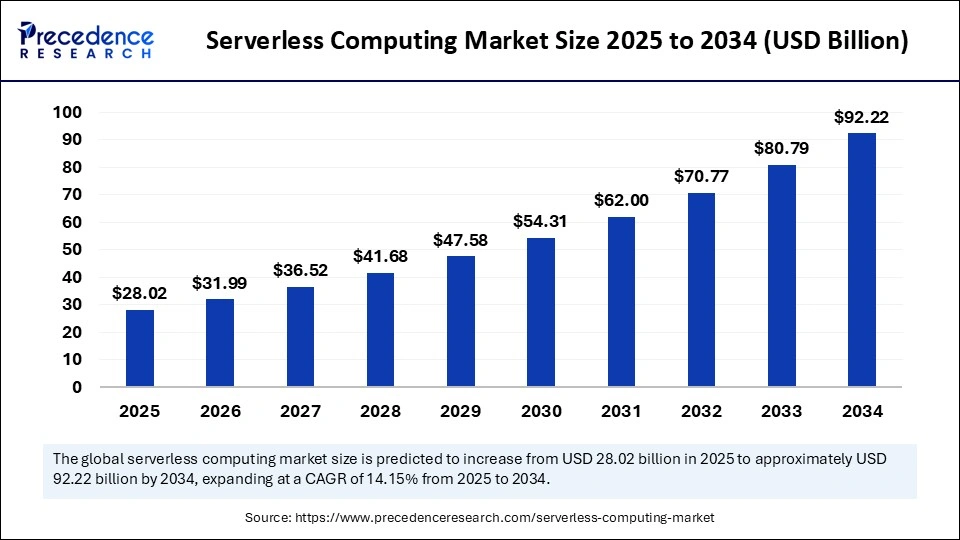
The global serverless computing market is officially exploding — and not quietly. According to Precedence Research, the industry will skyrocket from USD 28.02 billion in 2025 to an unbelievable USD 92.22 billion by 2034. That’s a massive CAGR of 14.15%, fueled by real‑time data needs, AI‑powered automation, microservices adoption, and the relentless push for businesses to move faster while spending less.

For businesses — especially small and mid-sized ones — this shift isn’t a buzzword trend. It’s a concrete pathway to agility, scalability, and cost‑efficient innovation. As adoption accelerates, cloud giants like AWS, Azure, and Google Cloud are in a full‑blown race to deliver tools that make “invisible infrastructure” the future of computing.

Why Serverless Is Suddenly Everywhere

Serverless isn’t magic — it’s modern cloud computing without the burden of managing servers. You focus on logic; the cloud handles the scaling, provisioning, and operations. As businesses embrace distributed, event-driven, cloud-native designs, serverless becomes the natural evolution.

Key 2024–2025 Findings:
  • 89% of enterprises now operate cloud‑native technologies (CNCF)
  • North America dominated 2024 with 40% market share
  • Asia Pacific predicted to grow the fastest through 2034
  • FaaS captured a strong 65% of the 2024 market
  • Public cloud reigned with a huge 70% share

The momentum is clear. Real-time analytics, fraud detection, IoT pipelines, and AI‑powered automation are rapidly shifting to serverless environments. With new runtimes, improved observability, and AI-driven scaling tools, the ecosystem is maturing at a breathtaking pace.

AI: The Silent Fuel Behind Serverless Growth

Artificial intelligence has become the quiet engine powering serverless adoption. Modern serverless systems can auto-optimize pipelines, detect anomalies, streamline traffic surges, and integrate with AI tools more seamlessly than ever. Industries from healthcare to retail are deploying AI‑enhanced serverless architecture to enable smarter automation and faster decision-making.

As serverless databases, vector stores, and real-time model serving become mainstream, companies now launch powerful AI-driven workloads without the complexity — or cost — of traditional infrastructure.

Where Serverless Is Growing Fastest

North America still leads the global market, propelled by AWS, Azure, and Google Cloud. The U.S. alone is on track to nearly double its serverless market, from USD 6.86B in 2025 to USD 14.40B by 2034.

But Asia Pacific is the region to watch. With monumental digital transformation movements — including Digital India and Singapore’s Smart Nation — cloud-native adoption is exploding. Rapid e-commerce expansions, mobile-first economies, and IoT development are accelerating this growth.

Meanwhile, Europe, Latin America, and the Middle East continue leveraging serverless to upgrade financial systems, urban infrastructure, and enterprise platforms.

What This Means for Small and Mid‑Sized Businesses

Serverless is nothing short of transformative for SMBs. No servers. No provisioning. No overpaying for idle infrastructure. You simply pay for what you use — and scale automatically when needed.

The World Economic Forum highlights that serverless computing significantly lowers innovation barriers, empowering smaller teams to build boldly and deploy rapidly without enterprise-level budgets.

Why SMBs love serverless:
  • No infrastructure to maintain
  • Rapid deployment cycles
  • Reduced operational costs
  • Effortless integration with AI, APIs, and automation
  • Ideal foundation for microservices and modern apps

And This Is Where TNT Nerds Steps In

At TNT Nerds, we leverage the power of serverless and cloud-native technologies to help businesses modernize without the usual headaches. Whether you need a scalable web platform, automated real-time workflows, AI-driven systems, or a fully serverless backend, our team delivers solutions that are secure, cost-efficient, and built to grow.

We turn serverless potential into real-world impact — optimized, future-proof, and ready for whatever comes next.

The Bottom Line: The Future Has No Servers

Serverless isn’t slowing — it’s accelerating. With billions pouring in, AI reshaping infrastructure, and global digital transformation ramping up, the next era of computing will be event-driven, automated, and cost-efficient by design.

For any business looking to innovate, scale, or reduce IT overhead, serverless isn’t just an option — it’s the new foundation of modern tech.

Curious how your business could use serverless, AI, or cloud-native development? TNT Nerds is ready to help you build what’s next.

The USD 92B Serverless Surge: Why Businesses Are Racing Toward an Infrastructure‑Free Future

The serverless revolution isn’t coming — it’s already reshaping the global tech landscape at full speed. With the market soaring toward USD 92.22 billion by 2034, companies of all sizes are ditching traditional infrastructure in favor of agile, event‑driven, AI‑powered systems that scale effortlessly and cut costs. From real-time analytics to AI‑native apps and microservices, serverless is quickly becoming the backbone of modern innovation. And for businesses looking to move faster without the overhead, the shift couldn’t come at a better time.
A speaker sitting on stage in front of a large OpenAI logo, gesturing with one hand during a presentation.

OpenAI Wants The Whole AI Stack. What Does That Leave For The Rest Of Us?

OpenAI is racing to own the entire AI stack, from custom chips and data centers all the way up to the apps that live in your browser, your job hunt, and eventually your pocket. To investors, that sounds like a textbook moat. To everyone else, it sounds like the internet we use every day could soon be running on a few private rails.This piece breaks down what OpenAI is really building, why it suddenly needs a mountain of cash to do it, and where that leaves the rest of us who are not sitting on a fusion startup, a chip team, and a SoftBank term sheet. If Big AI is going full stack, how do small businesses, indie developers, and regular humans keep a real say in the future of their own tech?
Read More
A white RGB gaming PC setup with keyboard and mouse next to a white gaming console and controller.

Stop Wasting Money on Gaming Specs That Do Not Matter: A 2025 Hardware Upgrade Field Guide

Ultra fast SSDs, ray traced shadows, AI upscaling, cloud gaming, quantum buzzwords everywhere. If you believe the marketing, you need all of it right now or you are not a real gamer.That is nonsense.In this TNT Nerds 4D breakdown, we strip the hype off modern gaming hardware and show you what actually changes your experience in 2025, what is safe to skip, and how to build or buy a rig that feels fast, looks great, and does not torch your wallet. Whether you are on console, PC, or a gaming laptop, we will walk through the upgrades that give you real world wins today while still keeping an eye on the free, open, user first future we actually want to live in.
Read More
A gloved hand interacts with digital security icons, including a padlock, cloud storage, user profiles, financial symbols, and a laptop, representing data protection and cybersecurity.

Healthcare Cybersecurity Is Failing At The Basics: How To Lock Down Today And Get Ready For The Quantum Tomorrow

Healthcare just had its worst year on record for breached patient data.Not because of ultra sophisticated nation state zero days, but because of the same old weak links: missing multi factor authentication, unpatched Windows boxes, and vendors nobody bothered to vet.At the same time, regulators are tightening the screws and quantum computing is quietly stalking our current encryption. That mix makes a lot of teams freeze. Do you fix today’s fires or prepare for Q day?You do both, but not the way the hype cycle tells you.In this TNT Nerds deep dive, we break down a practical, no nonsense roadmap for clinics, hospitals, and medical device makers: how to get the boring fundamentals right, make sense of the new regulations, and start building a quantum resilient security posture without blowing up your budget or your IT team.
Read More
Green smartphone with dual rear cameras held in a person’s hand

Best iPhone To Buy In 2025: Real Talk Guide To Apple Intelligence, MagSafe, And Your Wallet

Apple just dropped another alphabet of iPhones, and the internet is already drowning in spec sheets and sponsored “must buy” lists. Meanwhile, you just want to know one thing: which iPhone should you actually buy in 2025, and which ones are a waste of money?As your resident TNT Nerds tech brain, I am going to break this down the way you would if you had a weekend, a lab full of phones, and zero patience for marketing. We will walk through real life scenarios, not press release fantasy: the creator who lives in the camera app, the small business owner issuing phones to staff, the parent trying not to get locked into a painful carrier contract, the power user who cares more about battery cycles than titanium curves.We will talk Apple Intelligence without the hype, MagSafe and Qi2 without the buzzwords, and carrier deals without the fine print. By the end, you will know exactly which iPhone fits your use case, when it is smarter to buy last year’s Pro, and when the best move is to keep your current phone and just swap a battery.
Read More
A white cylindrical networking device with a glowing blue LED ring on top, placed on a wooden surface.

From Random Routers To A Real Network Brain: Why Unifi Feels So Good Once You Switch

Most of us live behind whatever plastic router our ISP tossed in the box years ago. It blinks, it mostly works, and when it does not, we simply reboot and pray. Then you try something like Unifi and suddenly your network stops feeling like a mystery and starts behaving like a system. This is the story of what changes when you move from random gear to a unified network brain, why it is so hard to go back, and how you can get there without breaking your budget or your sanity.
Read More